

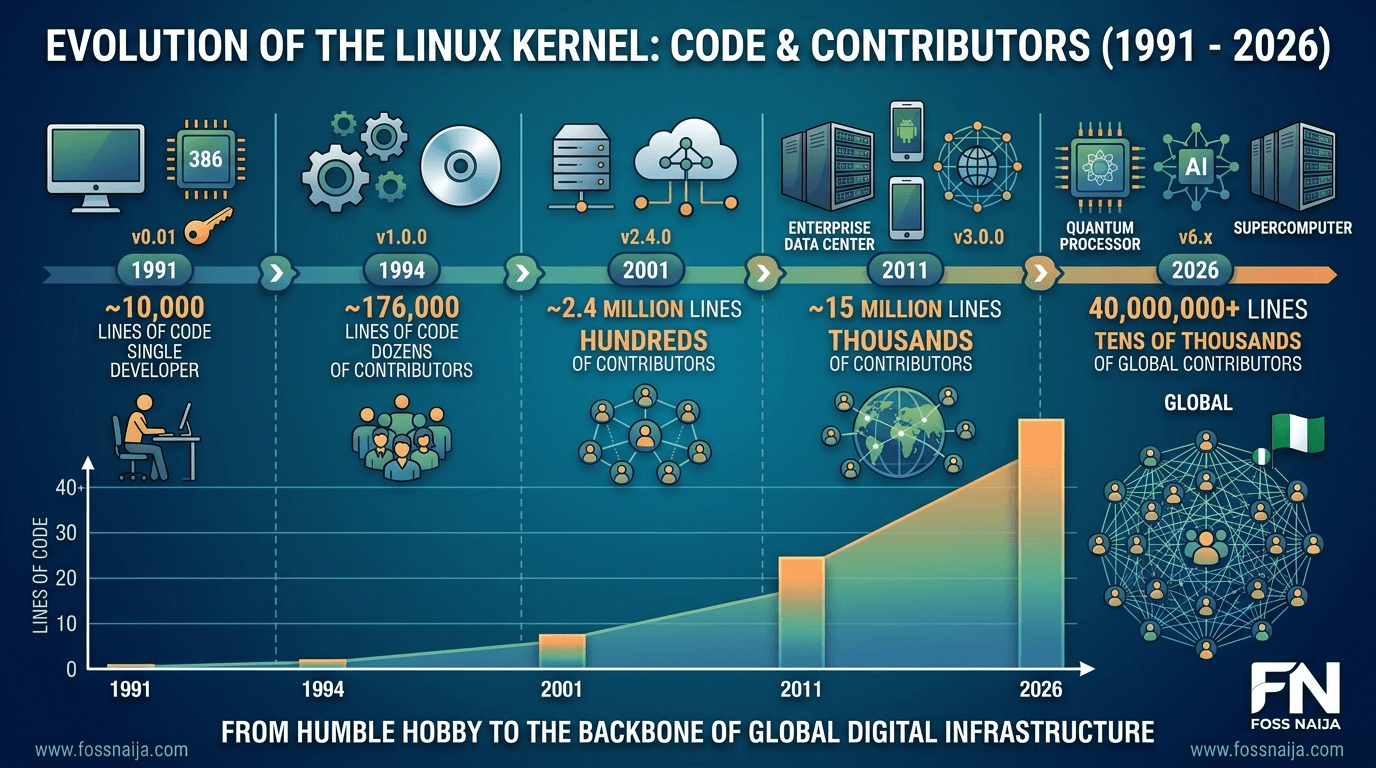
On August 25, 1991, a 21-year-old Finnish computer science student named Linus Torvalds opened his newsreader and posted a casual message to the comp.os.minix Usenet group:
“I’m doing a (free) operating system (just a hobby, won’t be big and professional like gnu for 386(486) AT clones). This has been brewing since april, and is starting to get ready. I’d like any feedback on things people like/dislike in minix, as my OS resembles it somewhat…”
Thirty-five years later, that straightforward and humble side project has become the most vital piece of software infrastructure in human history. The Linux kernel isn’t just the backbone of personal computers; it’s the unseen force driving the entire digital landscape.
It powers all of the world’s leading supercomputers, dominates the smartphone market with Android, supports most cloud infrastructure, and oversees essential hardware on the International Space Station and NASA’s Mars rovers.
As we mark the 35th anniversary of Linux kernel development, it’s a great time to look back at how this decentralized and collaborative effort has shaken up the world of proprietary software. It has not only transformed the global tech landscape but also continues to inspire and empower developers in Nigeria and throughout Africa.
From 10,000 Lines to 40 Million: The Growth of the Kernel
Back in September 1991, Linus Torvalds introduced the world to Linux version 0.01, which was a modest beginning with around 10,239 lines of code. It’s fascinating to think about how far it has come since then! It was closely linked to the Intel 80386 architecture, had no network drivers, and struggled to run even a simple Bash shell and GCC compiler.
In late 1992, a significant turning point in the history of Linux occurred with the release of version 0.99. It was during this time that Torvalds made a crucial choice to relicense the project under the GNU General Public License version 2 (GPLv2).

This “copyleft” licensing framework ensured that anyone had the freedom to view, modify, and redistribute the code, as long as all derivative works stayed open and free under the same terms. The GPL established a positive feedback loop: businesses were able to use and enhance Linux, but they had a legal responsibility to share their kernel improvements with the upstream codebase.
Today, the Linux kernel tree has grown to over 40 million lines of code, thanks to the contributions of thousands of independent developers and engineers backed by major tech companies such as Ubuntu, Red Hat, Google, SUSE, Intel, Meta, and IBM.
The 4 Pillars of Linux Dominance
Linux didn’t come out on top in the enterprise software battle by chance or just because of corporate support; it triumphed in modern computing thanks to its core architectural and economic strengths.
1. Exceptional Architectural Flexibility
Initially aimed solely at x86 PCs, early community initiatives showed that the kernel could be separated from particular hardware platforms. Today, Linux is everyplace! From low-power ARM microcontrollers to RISC-V experimental boards, it powers enterprise mainframes and even massive parallel supercomputers. It’s amazing to see how versatile and widespread Linux has become. If there’s a silicon chip out there that can do some computing, you can bet someone has figured out how to run Linux on it.
2. The “Many Eyes” Security Paradigm
Linus’s Law, crafted by open-source trailblazer Eric S. Raymond, suggests that with enough people looking at a problem, all bugs become easy to fix. In contrast to proprietary operating systems that often depend on keeping their code hidden for security, the open nature of Linux allows security researchers, academic institutions, and enterprise teams around the world to examine the code. This transparency makes it possible to spot memory leaks and quickly address zero-day vulnerabilities like never before.
3. Economic Democratization
Before the advent of Linux, setting up an enterprise IT infrastructure often meant shelling out millions in licensing fees for proprietary UNIX systems. Linux removed the financial hurdle of software licensing, making it easier for everyone to get started. This change significantly reduced the amount of startup capital needed around the world, setting the stage for the dot-com era, the rise of modern SaaS, and the widespread accessibility of cloud computing.
4. Modular Unix Design
Sticking to the timeless Unix philosophy of doing one thing and doing it well, the Linux kernel offers a streamlined abstraction layer that connects application software with the hardware beneath it. This design gives systems architects detailed control over crucial aspects like memory management, networking, and process scheduling.
Long live the kernel!
What started 35 years ago as a simple hobby project by a 21-year-old student has evolved into the driving force behind modern civilization. The tale of the Linux kernel showcases how the power of shared knowledge, when spread across the globe, can lead to results that far surpass what any one company could accomplish on its own.
As we gaze into the future of technology in Nigeria and beyond, one thing is certain: the open-source philosophy that emerged in 1991 will keep influencing how we create, expand, and innovate for many years ahead.
Linux’NG!

- 35 Years of Linux: How “Just a Hobby” Rewrote Global Computing - September 4, 2026
- How to Activate and Use Brave Browser Split Screen [Latest Update 2025] - October 14, 2025
- The End of an Era: Clear Linux OS Shutting Down - July 26, 2025